Ernest Hemingway
A Moveable FeastErnest Hemingway is both the central figure and the first-person narrator of A Moveable Feast, a portrait of an emerging writer learning to turn daily life into work. Its defining pattern is the movement between deprivation and creative discipline: a cold room and a dwindling budget sharpen his awareness, while walking and watching help him find what to write. The book also complicates its own authority. Hemingway allows that readers may regard it as fiction, while suggesting that fiction can illuminate what has been recorded as fact.
Identity and Narrative Frame
The book identifies Hemingway as its author and places its final framing in San Francisco de Paula, Cuba, in 1960. Its Paris is not presented as a neutral record but as a place recalled from a later vantage point, where remembered scenes carry the pressure of subsequent losses and changes. Hemingway is therefore both the younger writer moving through the city and the older narrator deciding how that earlier life can be told.
That double position shapes the account without resolving it into either pure fact or invented story. The invitation to read the book as fiction does not cancel its claim to illuminate experience; instead, it makes recollection itself part of the subject. The Paris Hemingway describes belongs to particular moments of poverty, work, companionship, and separation, but it is also a city remade by memory.
Work, Poverty, and the City
Hemingway’s working life is shown through material calculations as much as through literary ambition. In the first cold rains of winter, the city’s brightness disappears into wet streets and closed shop doors. He works in a top-floor room in the hotel where Verlaine had died, but heating it requires money for twigs, kindling, and wood. He considers the cost and the risk that a cold chimney will fail to draw, wasting both fuel and money, and walks on rather than light a fire. Poverty here is not an abstract condition: it governs whether a room can be warmed and how far a day’s money can stretch.
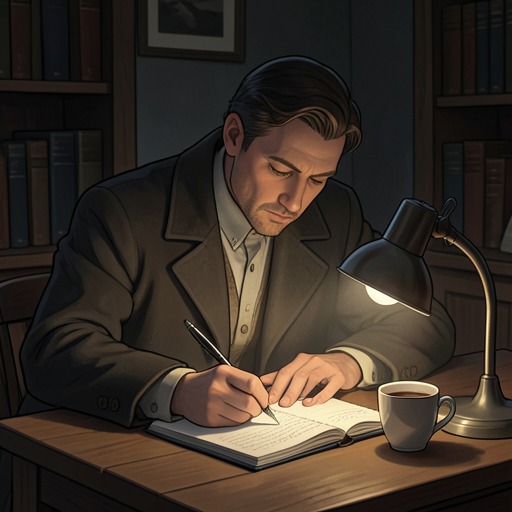
The walk becomes part of the work. In a warm café at Place Saint-Michel, Hemingway hangs his old waterproof and weathered felt hat to dry, orders café au lait, takes a notebook and pencil from his coat, and writes about Michigan. The cold, windy day outside supplies the weather of the story. As he writes about the boys drinking, he becomes thirsty himself and orders Martinique rum, which warms him and leaves him feeling well enough to continue. The scene connects bodily need, remembered landscape, and invention without separating writing from the conditions in which it happens.
Walking also gives Hemingway a way to think. He follows the quays after work or when trying to work something out, watching people occupied in tasks they understand. At the point of Île de la Cité below Pont Neuf, he observes fishermen adjusting their places to the river’s height and using long cane poles, fine leaders, light tackle, and quill floats. Their catches include Goujon, eaten whole, bones and all. He knows the fishing closely but does not take it up: he lacks tackle, would rather save money to fish in Spain, and cannot predict when work or travel will interrupt him. The choice marks the boundary between the city’s available pleasures and the discipline of keeping time and money for writing and other plans.
Loss and the Return to Writing
The theft of Hemingway’s manuscripts exposes how much of his early work has been made materially vulnerable. Hadley Richardson had packed originals, typescripts, and carbons in manila folders; only one story remained because it had already been sent to an editor and was still in the mail. Another surviving story, Up in Michigan, had not been copied after Gertrude Stein called it inaccrochable and had remained in a drawer. When Hadley Richardson tried to tell him what had happened, she cried and could not speak. Hemingway reassured her that they would work it out before discovering for himself, after taking the train back to Paris, that the loss was real.
He was earning good money in journalism and arranged for someone to cover his newspaper work so that he could return. His response does not make the loss painless; rather, he tries to contain it. Remembering Chink’s lesson never to discuss casualties, he reassures Edward O’Brien, who is deeply affected when Hemingway shows him a surviving racing story. Hemingway tells him he will write stories again, at first partly to comfort him, then recognizes that the promise is true. The movement from consolation to conviction gives the recovery its force: writing begins again not because the loss has been repaired, but because the work remains possible.
The first story he recalls writing after the loss is Out of Season, made in Cortina d’Ampezzo after he rejoined Hadley Richardson. It omits the old man’s suicide, an ending Hemingway had deliberately removed. He describes the omission as a developing theory: what a writer knowingly leaves out can strengthen a story and make readers feel more than they can explicitly understand. The story’s missing ending thus becomes more than a plot detail; it is an early statement of how restraint might make absence active.
Hemingway knows that a novel must eventually follow, but resists writing one simply because it is necessary or because regular meals depend on it. After losing an earlier novel with the stolen bag, he doubts the easy, youthful facility that had helped him write it and wants to let the pressure build. For the present, he will write a long story about what he knows best. At the Closerie des Lilas, he sets down a scene of returning from war without mentioning the war: the river and the country must carry what the story does not state. He leaves the café reluctant to leave the river behind, but the next morning will bring another day of making it on the page. Work becomes a daily commitment, sustained by the expectation that the scene will still be there to return to.
Friendship, Marriage, and Divided Loyalties
Hemingway’s account of his trip with F. Scott Fitzgerald combines companionship with practical effort. On the drive to Paris, Fitzgerald is cheerful and tells Hemingway the plots and characters of Michael Arlen’s books, offering what Hemingway describes as an oral education in a writer he says he cannot read. At meals Hemingway orders the lightest wine he can find and asks Fitzgerald not to let him order more than half a bottle, because he must train before writing. Fitzgerald cooperates, even giving Hemingway some of his share when he sees him growing nervous near the end of a single bottle. The episode makes their friendship a scene of mutual accommodation, though Hemingway’s account also registers the oddity of being instructed in books he does not intend to read.
After leaving Fitzgerald at home, Hemingway returns to his wife and goes with her to the Closerie des Lilas. Their reunion is happy and childlike after the separation. When she asks what he learned, he says that the trip has taught him never to travel with anyone he does not love. The lesson is not presented as a general rule detached from experience: it comes from the contrast between a taxing journey with a friend and the ease of being again with the person to whom he feels bound.
Later, the account of divided loyalties makes that bond more painful. Hemingway has to leave Schruns for New York to rearrange publishers. Once his business is done, he should take the first train from Gare de l’Est back toward Austria, but delays the first, second, and third departures because the woman he is in love with is in Paris. When he finally sees Hadley Richardson waiting by the tracks, with Bumby beside her, he wishes he had died before loving anyone but her. Her sun-tanned face, red-gold hair grown out awkwardly over the winter, and the boy’s winter-reddened cheeks make the reunion vividly specific; her welcome is affectionate and trusting, and she believes he has returned from a successful trip.
Hemingway says that he loves Hadley Richardson and no one else, and recalls that they work well and make long trips together during a period when he thinks they have become invulnerable again. The return to happiness does not settle the conflict. After they leave the mountains and return to Paris in late spring, the other relationship begins again. The account locates the change in the recurrence of the problem after a genuine interval of closeness, rather than presenting reconciliation as a final resolution.
Memory and the Ending of the Paris Years
The book closes by refusing a simple ending for either the city or Hemingway’s attachment to it. The first part of Paris has ended; Paris itself has not. Hemingway reflects that each person’s memory of the city differs and that people return to it despite its changes and whatever difficulties or ease attend the journey. His own final image holds poverty and happiness together: this was Paris when he and Hadley Richardson were very poor and very happy. The city’s value rests not on its remaining unchanged, but on the lasting force of what happened there and on the different meanings it can take in memory.